Eighteen years ago, at a small restaurant in Bath, England, a former head of the Royal Navy’s RCM program said something very poignant to me. It answers this question.
[Read more…]Your Reliability Engineering Professional Development Site
A listing in reverse chronological order of these article series:
by Nancy Regan Leave a Comment

Eighteen years ago, at a small restaurant in Bath, England, a former head of the Royal Navy’s RCM program said something very poignant to me. It answers this question.
[Read more…]by James Reyes-Picknell Leave a Comment

To get different results of any kind, we need to make changes. As human beings we are very good at change, but not so good at “being changed”. If we want it, it will happen. If we don’t want it, we will resist.
Physical asset performance is a result of having a robust and reliable design to begin with, the right maintenance executed the right way, and operation within the assets’ performance limits. In an existing operation, the design is fixed already. Maintenance and operations however, are not, and can often be improved, usually with considerable effort. That effort however, can be well worth it.
[Read more…]by Mike Sondalini Leave a Comment

Abstract: Do the reliability math on organizational structure design, and in a militaristic silo configuration you’ll see that managers have a huge influence on their departments performance. But what is most surprising is that supervisors in silo groups have more than double their manager’s impact on their group’s success. Managers making poor and wrong choices will cause serious trouble. But supervisors who get decisions wrong cause catastrophe.
[Read more…]by André-Michel Ferrari Leave a Comment

Traditional spare parts or inventory calculation methods involving Min-Max levels lack rigor, especially for critical equipment. Reliability, Availability and Maintainability (RAM) models provide a better approach to this calculation.
[Read more…]by Mike Sondalini Leave a Comment

The request in the box below was received by email.
[Read more…]I am contacting you to make you aware of Request, RFP# 68250, “Breakthrough Technologies for Pipeline Leak Detection.”
We invite proposals for breakthrough technologies for pipeline leak prevention, detection, and remediation. We have identified you as a party with the potential expertise to respond to this request.
by Nancy Regan Leave a Comment

To maximize the benefits, RCM should be applied as early in the lifecycle as possible, beginning with the design stage. But, most RCM analyses are done on legacy assets – in other words – on assets that are already fielded. And many are initiated decades after the system was fielded – especially in the case of government and military equipment.
by Lindsay Walker Leave a Comment

In the food industry, safeguarding consumers through meticulous food safety practices reigns supreme. Hazard Analysis and Critical Control Points (HACCP) serve as a cornerstone for food manufacturers, outlining a systematic approach to identify, eliminate, or minimize potential hazards throughout production. Preventive maintenance plays a vital role in mitigating risks associated with equipment failure, contamination, and other unforeseen circumstances. This article explores how a Computerized Maintenance Management System (CMMS) empowers food manufacturers to achieve HACCP compliance and cultivate a safe production environment. [Read more…]
by Karl Burnett Leave a Comment

By the 1906 revision of the Regulations, there were many more technical changes to manage. Most ships now had iron or steel hulls, which changed the mechanism of how a hull would fail. Galvanic corrosion and methods to prevent it were well understood. The chapter covering “Preservation, Repairs, and Docking” required zincs, the sacrificial anodes to be placed near the screws to prevent galvanic corrosion.
[Read more…]by Nancy Regan Leave a Comment

RCM is one of the most powerful maintenance and reliability improvement processes out there. The name Reliability Centered Maintenance lends itself to a process that’s used to develop proactive maintenance for an asset – and it is. But RCM can be used to formulate scores of solutions that reach far beyond maintenance.
[Read more…]
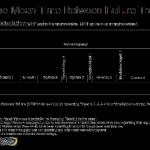
An MTBF calculation is often done to generate an indicator of plant and equipment reliability. An MTBF value is the average time between failures. There are serious dangers with the use of MTBF that need to be addressed when you do an MTBF calculation.
Take a look at the diagram below representing a period in the life of an imaginary production line. What is the MTBF formula to use for the period of interest to represent the production line’s reliability over that time? [Read more…]
by Ramesh Gulati Leave a Comment

Ramesh Gulati and George Williams discuss Certifications and the importance of obtaining them.
[Read more…]by André-Michel Ferrari Leave a Comment

Maintenance Optimization is a Reliability Engineering process which helps organizations avoid unnecessary spend whilst minimizing the risk of a costly failure. Planned replacements or inspections detect or prevent failures for components or systems with increasing failure rates. This improves asset reliability and helps control maintenance spend. Increasing failure rates refer to having a Weibull distribution shape parameter Beta (β) greater than one. Specifically, the failure rates located in the right section of the bath tub curve as shown in Diagram 1 below. Admittedly, the life characteristics have to follow a Weibull distribution in this case.
by Mike Sondalini Leave a Comment

When engineers design a machinery part, they begin by defining the operating load range it will experience during its service life. This range will include the loads when the machine part is not working through to the maximum stress that it will operate under. Examples of high stress situations include operating overload events, or when starting up under a large load. How great the imposed stress reaches and how often those events occur changes a part’s reliability.
[Read more…]by Nancy Regan Leave a Comment

Reliability Centered Maintenance principles will be celebrating their golden anniversary soon. And you may be surprised where the process finds its roots!
[Read more…]by Nancy Regan Leave a Comment

There is a big difference between Preventive Maintenance Optimization (PMO) and Reliability Centered Maintenance (RCM). Daffodils are a perfect way to explain the difference.
[Read more…]
Ask a question or send along a comment.
Please login to view and use the contact form.