
Unless you live in Fantasyland, there’s no silver bullet for achieving your equipment Reliability goals. Start at the beginning, with Reliability Centered Maintenance and watch your Reliability program come to life. [Read more…]
Your Reliability Engineering Professional Development Site
A listing in reverse chronological order of these article series:
Unless you live in Fantasyland, there’s no silver bullet for achieving your equipment Reliability goals. Start at the beginning, with Reliability Centered Maintenance and watch your Reliability program come to life. [Read more…]

Fatigue regulations and guidelines have been long established in aviation, transportation and the nuclear industries (just to name a few). The science is solid supporting the correlation between human fatigue, and poor decision-making/poor responsiveness.
So why aren’t such fatigue regulations required in healthcare as a matter of standard like in other industries? Is there something different about the physiology and/or anatomy of a healthcare worker versus a pilot, truck/bus driver or nuclear operator? [Read more…]
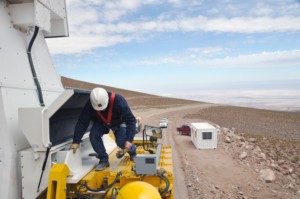 Ever wonder how some organizations make their vibration or thermographic program work, and not only work but deliver huge results to their organization? They use a systematic approach to establishing the correct frequencies of inspection. Establishing the correct frequencies of maintenance activities is critical to the success of any maintenance program. Too infrequently and the organization is subjected to failures, resulting in poor operational performance. Too frequently, and the organization is subjected to excess planned downtime and an increased probability of maintenance induced failures.
This article will continue the discussion on establishing the correct frequency in a maintenance program. There are three different approached to use, based on the type of maintenance being performed;
This article will focus on On-Condition Maintenance. While establishing the frequency for Fixed Time Maintenance activities is complex and is more of science, establishing the frequency for Condition Based Maintenance inspections (or On-Condition) is a mix of science and art.
The first step to determining the inspection frequency for on-condition tasks is to construct the P-F curve and P-F interval. Constructing a P-F curve requires recording the results of the inspection and plotting the result versus the elapsed time. If enough measurements are taken, a fairly consistent curve can be developed for each failure mode. Making sure that the data is gathered carefully and consistently will aid in increasing the quality of the P-F curve. Lets use an example from RCM2;
Now this works quite well for linear P-F curves because it is predictable. So how do you construct a P-F curve for a non-linear failure mode? It is a bit more complex, and a bit more of art. Let’s use another example;
With P-F curve and P-F Interval (PFI) established, the frequency can be determined.
Once the P-F Interval (PFI) is established, the inspection frequency can be determined. Thankfully it is not as complicated as establishing Fixed Time Maintenance frequencies. To determine the inspection frequency, the formula is either PFI/3 or PFI/5.
Now the above works well for linear P-F curves, so how do you establish the frequency for the non-linear curves? You use the same approach as above for the initial inspection frequency.
However, once a potential failure is detected, additional readings should be taken at progressively shorter intervals until a point is reached that a repair action must be taken. For example; the initial inspection frequency is every four weeks. Once a defect is detected, the next inspection will be at three weeks, then two weeks and then ever week.
This is only guidelines and should be adjusted based on the method used to track and trend data, the lead time of the repair parts (if not kept on site), and how quickly the data will be analyzed, and the repair work planned. If your planning process is poor, the frequency should be more frequent, to allow for a high chance of detection sooner.
How much thought was put into your Condition Based Maintenance inspection frequencies? Have you broken down each failure mode trended the data and established the frequency using a systematic approach? As with the Fixed Time Maintenance activities, you may be over or under inspecting, costing your organization reliability or money.
Remember, to find success; you must first solve the problem, then achieve the implementation of the solution, and finally sustain winning results.
I’m James Kovacevic
Eruditio, LLC
Where Education Meets Application
Follow @EruditioLLC
References;

… is the world’s leading method for identifying maintenance and other activities required to sustain reliable performance of physical assets. Previously I discussed the various maintenance approaches you can use. This method (RCM-R®) is a structured approach to making those choices. If you want a proactive maintenance program that really works, then Reliability Centered Maintenance is the most thorough approach you can take to get there.Since the 1970’s RCM (generic) has been responsible for huge improvements in airline flight safety – crash rates today are 1 / 120th of what they were before RCM, and the costs of aircraft maintenance programs are way down. We are all comfortable flying in safety. That would not be the case had RCM not come along. [Read more…]

It is often wrongly believe that ALL Failure Modes should be included in an RCM analysis. RCM gives us four specific criteria that dictate what Failure Modes should be in included in a properly executed RCM analysis. They are… [Read more…]

[Editor: originally posted Jan 23, 2015]
For those that are football enthusiasts and looking forward to the upcoming Superbowl, we are intrigued by the recent scandal in the NFL. The scandal involves the allegation that somehow the New England Patriots’ footballs used in the game against the Colts last week, were deflated and did not meet the minimum PSI requirements of the NFL to be ‘legal’ for game use. The allegation involves the possible tampering of the NE footballs to attain that ‘deflated’ state. Conceivably this would make it more desirable to throw and catch in the conditions of the game. [Read more…]
 Think about your maintenance program. How often are your PMs scheduled? How were those frequencies established? If you are in the majority, the chances are that the frequencies were either established from the OEM manual, or by someone in the department without data.
Establishing the correct frequency of maintenance activities is critical to the success of any maintenance program. Too infrequently and the organization is subjected to failures, resulting in poor operational performance. Too frequently, and the organization is subjected to excess planned downtime and an increased probability of maintenance induced failures. So how do you establish the correct maintenance frequencies for your organization? There are three different approached to use, based on the type of maintenance being performed;
This article will focus on Time Based Maintenance Tasks.
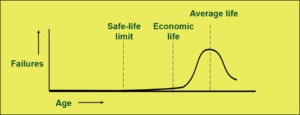
“The frequency of a scheduled task is governed by the age at which the item of or component shows a rapid increase in the conditional probability of failure” (RCM2). When establishing frequencies for Time Based Maintenance, it is required that the life be identified for the component based on data.
With time-based failures, a safe life and useful life exists. The safe life is when no failures occur before that date or time. Unless the failure consequence is environmental, or safety related, the safe life would not normally be used. The useful life (economic life limit), is when the cost of consequences of a failure starts to exceed the cost of the time-based maintenance activity. There is a trade-off at this point between the potential lost production and the cost of planned downtime, labour, and materials.
So how is the safe life or useful life established? It is established using failure data and history. This history can be reviewed using a Weibull Analysis, Mean Cumulative Failure Analysis or even a Crow-AMSAA Analysis to statistically determine the life of the component. Once that life is determined using a statistical analysis, the optimum cost effective frequency must be established.
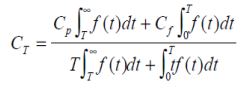 This formula is used to establish the economic life of the component, balancing the cost of the downtime vs. the cost of the replacement.
Where;
The formula will provide the total cost based on the maintenance frequency. Since the calculation can be time-consuming, Dodson developed a table which can be used if;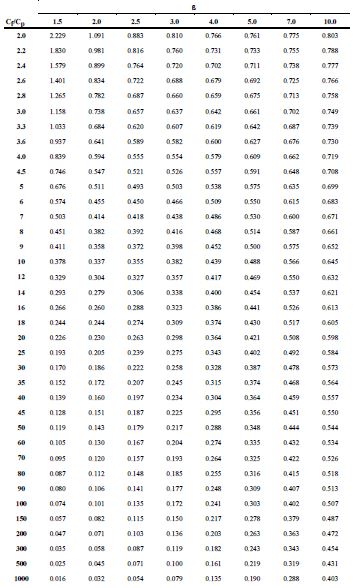
Therefore when using the table, use formula; T=mѲ+δ. Where;
In the example below, you can see how the table can be used with the formula;
The cost for a PM activity $60. The cost of a failure for the same item is $1800. Given the Weibull parameter of B=3.0, O=120 days, and δ =3 how often should the PM be performed?
The table value of m given a shape parameter B of 3.0 is 0.258. Therefore;
As you can see, determining the frequency of Fixed Time Maintenance tasks is not as simple as picking a number out of a manual or based on intuition. Armed with this information, a cost effective PM frequency based on data can be developed for your Fixed Time Maintenance tasks. This will ensure the right maintenance is done at the right time, driving your plant performance further.
Does you Fixed Time Maintenance Tasks have this level of rigor behind them? Why, not? After all, your plant performance (operational and financial) depends on it. Stay tuned for next week’s post on establishing frequencies for On-Condition tasks.
Remember, to find success; you must first solve the problem, then achieve the implementation of the solution, and finally sustain winning results.
I’m James Kovacevic
Eruditio, LLC
Where Education Meets Application
Follow @EruditioLLC

Do you replace your car headlights at regular intervals of six months? Do you wait to replace your tires until they wear through? Do you check your car engine oil with some sort of oil analysis before replacing it? Each component and system in your car has a function that is prone to failure. Each of those has consequences – some with little importance and others with great importance. [Read more…]

When it comes to Physical Asset Management, we have to think beyond maintenance and remember that there are a lot of other things we have to consider… [Read more…]

Maintenance of different equipment within a facility remains a core enabler of improved productivity and efficiency of plant processes. Poor maintenance practices lead to machine downtime, increased operational costs, and increased maintenance workloads.
Reducing maintenance workload can’t be done overnight, but it is a goal worth pursuing. Less maintenance work performed (without an increase in reactive maintenance work) means less resources spent – fewer spare parts used, less overtime work, and improved employee satisfaction that can actually increase the average quality of performed maintenance work.

As a key attribute of High Reliability Organizations (HRO), what’s wrong with a questioning attitude? One the surface it would seem like this is something we would encourage all of our employees to do. Certainly they ask such questions because they seek legitimate answers, right? We wouldn’t want to discourage that behavior, would we? [Read more…]
 Most maintenance and reliability professionals have seen the six failure patterns (or failure hazard plots), described by Nowlan and Heap. In case you are unfamiliar with them, you can learn more about them in a previous article on them. Here is a quick summary to jog the memory, just in case.
From the above, you can see that the majority of failures experenced are not directly related to age, but are the result of random or induced failures. So how does this help when establishing a maintenance program? First, we must understand what the patterns tell us.
Looking at the different failure patterns, we can group the types of failures into three unique groups;
Understanding these unique differences, an effective maintenance strategy can be developed.
The maintenance activity selected has to be right for the specific failure pattern. When looking at the failure patterns, there are three unique types of activities that can be put in place to address all points in the failure curve.
Only when a maintenance program encompasses all of the above activities, can plant performance improve.
So with all of the activities taking place, how is it possible to know when each fixed time activity or condition monitoring inspection take place? The approach to determining the frequency of activities for fixed time and condition monitoring inspections are different. However, before the approaches are discussed, it should be noted that MTBF should NOT be used to determine the approach… EVER (sorry, the rant is over).
I hope this has provided some clarity around how you should be using the six failure patterns in your maintenance strategy. Do you have specific activities in your program to address age-related, random and infant mortality failures? If you only have fixed time maintenance activities in your program, what are leaving on the table?
Remember, to find success; you must first solve the problem, then achieve the implementation of the solution, and finally sustain winning results.
I’m James Kovacevic
Eruditio, LLC
Where Education Meets Application
Follow @EruditioLLC
References;

The cornerstones of effective maintenance management are maintenance planning and scheduling, which ensure that maintenance technicians are at the right place at the right time with the right tools. Effective maintenance planning and scheduling involve prioritizing and organizing work so that it is completed in the most efficient manner possible. The advantages of proper maintenance planning and scheduling include the following:

Skilled labor is in short supply. Companies are struggling to find talent. Education systems throughout North America have done a poor job of producing ‘job ready’ graduates. Companies have cut back on training and apprentice program funding. Immigration programs did not prioritize the intake of needed and ready-to-us skills. Governments have been slow to see the problem and even slower to act on it. [Read more…]

The most beautiful jewelry reminds me about something very important when it comes to Physical Asset Management. In our organizations, the untapped gold is… [Read more…]