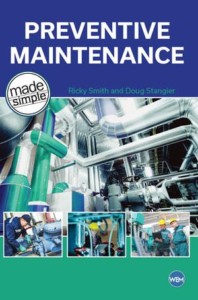
 I recently had the pleasure to interview Doug Stangier, co-author of Preventive Maintenance Made Simple. This is another excellent book in the Made Simple series, published by ReliabilityWeb. During the interview, Doug not only provides insights into his book but also into what world class Preventive Maintenance looks like. Anyone new to maintenance and reliability, or seasoned experts can benefit from this great book. Without further delay, here is the interview with Doug.
on Maintenance Reliability
A listing in reverse chronological order of these article series:
- Usman Mustafa Syed — Aasan Asset Management series
- Arun Gowtham — AI & Predictive Maintenance series
- Miguel Pengel — Asset Management in the Mining Industry series
- Bryan Christiansen — CMMS and Reliability series
- James Reyes-Picknell — Conscious Asset series
- Alex Williams — EAM & CMMS series
- Nancy Regan — Everday RCM series
- Karl Burnett — History of Maintenance Management series
- Mike Sondalini — Life Cycle Asset Management series
- James Kovacevic — Maintenance and Reliability series
- Mike Sondalini — Maintenance Management series
- Mike Sondalini — Plant Maintenance series
- Andrew Kelleher — Process Plant Reliability Engineering series
- George Williams and Joe Anderson — The ReliabilityXperience series
- Doug Plucknette — RCM Blitz series
- Robert Kalwarowsky — Rob's Reliability Project series
- Gina Tabasso — The Intelligent Transformer Blog series
- Tor Idhammar — The People Side of Maintenance series
- André-Michel Ferrari — The Reliability Mindset series
Taking a Lean Approach to PM Optimization
How You Have Your PMs Addressing The Right Issues, Make The Effective
 In the previous articles, we looked at what type of analysis to use to evaluate the effectiveness of the PMs and if they are cost effective. Once the PMs have been optimized to ensure they are addressing the right failure modes, then they need to be made efficient. Below is an excerpt from a recent article in SMRP’s Solutions Magazine on how to make PM efficient using the lean tools.
Is Your PM Worth Doing? Use a PM Cost Benefit Analysis to Find Out
How To Determine If The PM Activity Being Performed Is Worth Doing
 Would you spend $100 every week to prevent a possible issue that will result in a loss of $10? Probably not, so why is that we do that with our maintenance programs every single day? Often, PM and PdM activities are put into place without any thought to the economic impact of the activity. While in theory the PM or PdM activities will prevent or mitigate the consequences of the failure, is implementing one of these activities the right thing to do?
Inspired By Art to Learn a Trade – Lieutenant John Grieco RFD

Nearly 10 years ago, on an early morning trip to Rochester, New York’s Public Market, my wife and I walked by an old quonset hut where I could see an artist was using a cutting torch to heat and shape a piece of metal. With his back to the street, the light emanating from the torch outlined his body in a flashing smoke-filled halo. While I focused on this image, my wife Leslie was eyeing up the Artists’ work that was proudly displayed outside his shop.
“He does nice work, we should stop on our way out of the market and look around.”
That day would be the first of many trips we would make to the Lasting Art shop.
John Grieco is a Firefighter, Business Owner and Artist from Rochester, NY. If you live in the Rochester area or for that matter, anywhere in Western, New York, you have seen some of John’s amazing metal work. [Read more…]
Linking Failure Codes To A Proactive Maintenance Strategy
Using Failure Data to Drive Sustainable Improvements
 If you are lucky enough to have good failure data history in your CMMS, you are one of the few. But even if you have the data, can you use it to make a difference to your organization? Obviously, the data can be used to perform certain reliability engineering analyses, but what can those without reliability engineering experience do with the data?
From Millwright To World-Class Manufacturing – Kirk Wolfinger

I’ve always been proud to say that the first customer I provided RCM training and consulting for was Whirlpool in Findlay, Ohio.
Having just presented at SMRP’s annual conference in Denver, Colorado, I received an e-mail from Kirk Wolfinger who at the time was Whirlpools’ Maintenance Manager. Kirk wanted to know if I could come to Findlay and help his team get started in Reliability Centered Maintenance.
I was that one phone call that gave me the courage to leave Eastman Kodak and start my own company. [Read more…]
What Keeps The Fire Burning?

I’ve been proving RCM Facilitator Training for over twenty years….
I ran into an old friend at a conference recently and after we chatted about the things going on in each of our lives he asked me a series of questions that caught me a bit off guard.
How much longer do you plan to work?
Don’t you get sick of the travel?
You’ve been teaching and facilitating Reliability Centered Maintenance for over twenty years, doesn’t doing the same thing all the time get boring?
Have you ever thought about teaching other courses just to change it up a bit?
What motivates you to keep doing what you’re doing? [Read more…]
Marc Zimmerman – Large Capital Project Manager
The first person I selected to write about is one who I consider a mentor. I met Marc Zimmerman in February of 1981, at the time he was a Journeyman Pipefitter in Kodak’s Polymer Department and I remember watching him work, making precise gore cut fittings and just being in awe of craftsmanship it takes to calculate, lay-out, cut and assemble these pieces. [Read more…]
Finding A Life In The Skilled Trades – My Start
I’ve always considered myself to be somewhat lucky in life. I survived being hit head on by a car when I was five years old. I grew up in a small town in Upstate NY that had little to do in the form of entertainment but a lot to offer those in search of a sound middle class life. While I still live in that same town it has transformed from a farming community to a suburb of Rochester. I have raised my children in this same town my parents and grandparents called home and my grandchildren are being raised here as well. While life is good in our Village whose slogan is “Someplace Special” the opportunities available to my generation aren’t what they used to be. Today, it’s tough to be lucky.
When I look back, I don’t have to think too hard to know why life turned out so good. I learned a trade. [Read more…]
The 5 Rights and Wrongs of OEE

When I started to develop the RCM Blitz™ methodology over twenty years ago, the one thing I knew that would help to ensure successful Reliability-Centered Maintenance analysis was to develop a way that would guarantee every implemented analysis would provide a return on investment. The answer to this was simple enough, if you’re looking to improve safety and reduce health, safety and environmental incidents we should focus on critical assets that are struggling to maintain their inherent designed reliability. The best way to identify the best candidates is by measuring the OEE (Overall Equipment Effectiveness) of your top critical assets. [Read more…]
Budgets — What to Do and How to Use Them
Budgets represent plans or expectations for the future! They are a means to plan, forecast, coordinate and control the activities needed to achieve the business’ objectives. The budget document contains the amount of money that has been allocated to achieve those goals and the timing of its spending. Budgets cover the planned use of men, materials, external resources and management effort that is expected to be sufficient to hit the targets. Once the budget is finalised it becomes a tool to feedback how the actual progress is going compared to what was expected. [Read more…]
Tracking Belts on Bucket Elevators and Short Belt Conveyors

Tracking belts on bucket elevators and short belt conveyors. Flexible, flat belts are used on bucket elevators and belt conveyors to carry loose, bulk product. The belt is stretched tight from head drum to tail drum and the friction generated on the turning head drum is used to drive the belt and carry the product. The belt must run true on the end pulleys (drums) and stay within the sides of the equipment structure. If the belt runs off the drums, buckets will be destroyed and belt edges frayed. In the worst cases the belt runs off the pulleys resulting in a breakdown repair. Proper and long- lived tracking of belts is critical for trouble-free operation. [Read more…]
Dust Bag Selection for Bag-Houses

Bag house dust bag selection. The dust bags within a bag house must handle the process conditions they experience. The choice of bag materials is usually based on the cheapest fabric that will handle the conditions for a minimum of 3 to 5 years’ operation. The selection of the bag materials requires a good understanding of the process temperature, moisture content, chemical reactions with the bag fibre, dust loading effects and behaviour of the dust bags in operation. [Read more…]
Membrane and Leaf Filtration Overview

One method to clean particles from a liquid or gas is to pass it through a filter. The filter is a screen that traps and holds the contaminants on its surface while allowing the fluid to twist its way past the build-up and screen. The screen can be used until the back- pressure from the collected contaminants choke it so severely that the fluid flow falls drastically. At that point the screen must be cleaned. This article explains how membrane and leaf filtration processes work and the critical factors that produce successful filtration results. [Read more…]
The P-F Curve Revisited
Understanding The Importance of Proper Equipment Installation
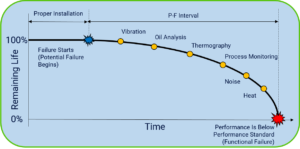 There has been much discussion (and often debate) around the P-F curve. The P-F curve illustrates the relationship between the warning signs that are detectable by various technology or methods and the progression of the failure. What is often not discussed and overlooked, is what happens before the equipment starts to deteriorate.
If the ultimate goal of an organization is to be proactive and ensure equipment uptime, wouldn’t the organization want to prevent the equipment from failing in the first place and not catch it after it has already started to fail? [Read more…]
- « Previous Page
- 1
- …
- 70
- 71
- 72
- 73
- 74
- …
- 97
- Next Page »