
As organizations focus more on data, the quality of data is important. But what does it mean? How do we know if we have it? This video provides some insights for understanding your data situation. [Read more…]
Your Reliability Engineering Professional Development Site
Find all articles across all article series listed in reverse chronological order.
As organizations focus more on data, the quality of data is important. But what does it mean? How do we know if we have it? This video provides some insights for understanding your data situation. [Read more…]

Sometimes I see images that speak strongly to how reliability engineering affects us everyday. Think of how many items you own or use systems that you wouldn’t touch/interact with if you couldn’t be absolutely sure they would work as expected. I wouldn’t use my microwave if I thought there was a 1/1000 chance it would catch fire. The amount of faith I have in traffic lights working correctly is astounding. If they malfunction it could be fatal.

One of the most important principles in reliability engineering and management is the differentiation between the vital few and the trivial many. The application of special product characteristics uses that principle.
“The whole of science is nothing more than the refinement of thinking.” – Albert Einstein

You’ve acquired and are now implementing a new CMMS / EAM (Computerized Maintenance Management System / Enterprise Asset Management) computer software program to help you manage maintenance. It may be a simple functional system that only looks after maintenance and likely Maintenance, Repair and Operating (MRO) spares, or it may be part of a much bigger enterprise system that handles many business functions. Regardless, one question almost always arises when converting from one to another system – what should we do about our old data? [Read more…]

What is quality? In a manufacturing or heavy industry, it is to minimize the defects and errors. Today it emphasizes customer satisfaction as well. It means quality is achieved if in the end the customer or user can effectively use the product. High quality is important to project success. Poor quality has a cost. [Read more…]
Design of Experiments is a great approach for confident modeling of systems. It does have limitations. What are the limits? How can those be dealt with? How important is it for practical systems? [Read more…]

by Alan Ross
“Why don’t they care?”
“About what?”
“About electrical system reliability?”
“Who says they don’t care?”
“You do. Quite often, as a matter of fact.” [Read more…]

I am often asked, what is the benchmark for a particular KPI. At first, I would quickly answer the target from the SMRP Best Practices Guide. Depending on the organization and the maturity, I would either see their faces light up or see them shut down. If they shut down, what momentum was present, quickly vanished. If they were meeting the target (and the KPI and supporting data checked out), the momentum would fade a bit, as they were hitting the target.

Emergency maintenance is the maintenance required when an asset suffers an unexpected functional failure. Typically, such failures can halt production lines and disrupt business operations until fixed.
Emergencies almost always happen without prior warning, and hence emergency maintenance is not one that can be preemptively scheduled – but it can definitely be planned for and efforts made to reduce its business impact when they do occur.
Technology provides us with some fantastic tools to help us work better, smarter, faster and more efficiently. BUT, it doesn’t help us think any better. We can actually get too dependent on it and our thinking is weakened. If you don’t believe that, just watch what happens when you try to buy something and the computerized cash register goes down. Can they actually take payment? And if you use cash, can the clerk make proper change without looking at the cash register to tell them how much to give you. [Read more…]

We rely upon skilled, able and talented individuals to assist in the successful delivery projects and improve businesses. They are gifted in their niche areas of expertise and without their stellar performances, where would we be? They are akin to the Prima Donna of an operatic performance and they are respected for their superior skills and ability. But when respect turns to reverence the lesser mortals around them may flail in the wake of the rising star. Such reverence may well inflate egos and a “Prima Donna” in the derogatory sense of the term may well emerge. As their egos grow their belief in their own abilities increases and they begin to ignore reality, make facts fit their needs, and take refuge in an ivory tower from where they may look down from on-high with their heads shrouded in the clouds of sanctimony. [Read more…]
Metropolises in 2020, like New York and Shanghai, disconcertingly resembled London in 1831, in that a strange new disease passed through the population leaving in its wake confusion, grief and death. 2020 was beginning of Covid-19; 1831, Cholera. [Read more…]
Many organizations are using online meetings. With work from home being so popular, this is an important area to improve. How can they be used to be more effective? How can a leader make the most of the meeting, and the features available? Which options are best for a given situation? [Read more…]
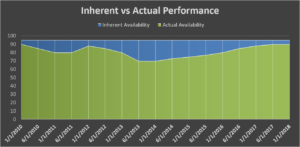 I recently had the opportunity to teach a Body of Knowledge course, which was full of great questions from the students. One of the questions was about inherent vs. actual availability. This had me thinking about the choice that organizations make on how they choose to run their business and more importantly, their resources.
There are many times when a resource is operated at Peak Inherent capability, with the intention of getting the most out of the resource. while this is a good practice, many organizations try to operate the resource at greater than the inherent capability of the resource. So, what does this do to the resource? Well, it could mean short-term financial gains, achieving the schedule, or if done for a sustained period of time, it could be detrimental to the resource.
Even if you have excellent planning and scheduling, you may still experience excessive downtime. Some consultants will promise that you’ll save a great deal of money with good P&S simply because planned and scheduled work is less expensive to execute. They are partially right too! But that’s only part of the picture. [Read more…]