A part of the preparation for the ASQ CRE is experience and education. These, in my simple way of thinking, means applying what you have learned to solve problems and provide value. Reliability engineering is about two questions: [Read more…]
Life Testing Question

Hi Fred,
I would take this opportunity to ask the reliability guru about bathtub curve for hardware reliability. I am running 27 units for life test for a million cycles around 555 hours. I have one failure at 300,000 cycles, and the rest of the units are running fine. Would this be classified as an early life failure? Also, how do I make a determination of when the early life failure time interval ends and constant failure rate starts in this example based on failure rate of remaining units? Thanks. [Read more…]
CRE Primer Error

Update:
I forwarded the note below to QCI for comment and asked if they have an errata available. They do.
The QCI errata is posted on [the] website. [Read more…]
Reading a Datasheet

Reading a datasheet to determine a reliability value may take some investigative work. Whenever I see a fit rate based on failure-free testing, I am curious about how they did the testing and the calculations. [Read more…]
Parallel Systems

Speaking reliability-wise, parallel, means any of the elements in parallel structure permit the system to function. This does not mean they are physically parallel (in all cases), as capacitors in parallel provide a specific behavior in the circuit and if one capacitor fails that system might fail.
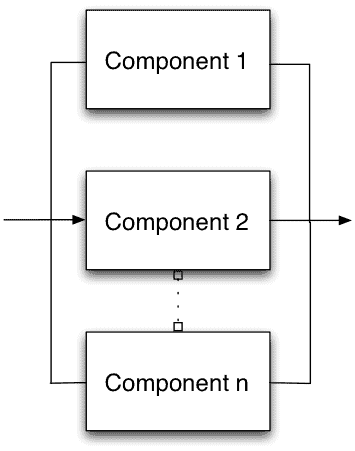 In this simple drawing, there are n components in parallel and any one component is needed for the system to function. [Read more…]
Value of CRE
The annual salary survey done by American Society for Quality (ASQ) is summarized in the December 2011 issue. And, the good news is a CRE certification provides approximately a $21k salary premium over those in similar positions without the certification. Based on Table 2. salary premiums for certification holders in the article, Land the Big One, indicated the largest premium is [Read more…]
Weakest Link

Each piece of gear used in rock climbing has the potential to be the weakest link. Often, based on accident reports, it the human decisions or lack of focus that is the most difficult to improve.
Ropes, anchors, harness, and carabiners and another equipment all have to work in the event of a fall. The design of each piece of equipment is to meet and hopefully exceed any possible load. And, to maintain the needed strength over years of harsh outdoor use. [Read more…]
Extended Bogey Testing
Reaching for a goal may include taking some risks. In reliability testing, we are often limited by the number of samples available for testing. And, in the case where time is available or the acceleration factor is high we can take advantage of testing longer. [Read more…]
Sample Size Success Testing

One of the most often asked questions of reliability professionals (or statisticians) is related to how many samples for a test? This typically is not an easy question to resolve without some work and knowledge of the testing in question. We are often asked anyway, and expected to have an answer.
While not the most often asked question on the CRE exam, you might see something related. Budget planning, prototype counts, test equipment sizing, etc. all need an estimate for sample size. [Read more…]
Reliability Apportionment

Diverging from reliability statistics for a post or two, let’s consider one way which R(t), reliability at time, t, is useful during the design phase of a product. Apportionment is the breakdown or allocation of reliability goals or objectives to elements within the product.
Overall, the product’s reliability is just one number, and it represents what the customer will experience with the product. During design, we often work on subsystems and components. Having a meaningful way to describe the reliability requirements that also assists the team to meet the overall product goal, is, well, useful. [Read more…]
Statistical Terms about Variation

“Statistics is the language of variation.” I’m sure that is a quote by someone, not me, though. It is true. Statistics is all about variation. In this post let’s explore some of the ways statisticians talk about data and specifically the amount of dispersion in the data. [Read more…]
Statistical Terms

This is hopefully completely a review. The mastery of basic statistical terms is important as many of the questions on the CRE are statistical in nature and rely on your understanding the terms. Let’s simply review the terms, and do let me know if you have any questions.
Let’s take a random sample from a population. Given a [Read more…]
Role of Reliability Statistics

Generally, I do not talk about statistics before 10am – it’s not polite.
As a reliability professional, statistics is a central feature of the value I bring to the team. And, not just the reliability statistics, all stats. It continues to amaze me how many engineers, scientists, and professionals tend to avoid statistics. [Read more…]
The Four Functions
There are four functions related to life distributions of importance to reliability engineering.
Nearly all textbooks on reliability either introduce or use these functions. Likewise, nearly every calculation related to reliability statistics also uses at least one of functions.
Suppose we produced 100 units of a product and tracked them all till failure over time.
Eventually, all of them would fail. And, unlike the Parson’s One Hoss Shay the products and their components would not all fail at the same time.
One way to track the failures over time is to use a simple histogram.
By plotting the number of failures each month, for example, we would [Read more…]
Basic Statistics

Understanding the math is critical not only for the exam, but it is also important for your ability to function as a reliability professional.
Most of us did not enjoy our undergraduate statistics course. It was just another course to endure as part of being in an engineering or science track.
The basic concepts and approaches to working with data are fundamental for some many situations. [Read more…]