Accendo Reliability

Your Reliability Engineering Professional Development Site

  • Home
  • About
    • Contributors
    • About Us
    • Colophon
    • Survey
  • Reliability.fm
    • Speaking Of Reliability
    • Rooted in Reliability: The Plant Performance Podcast
    • Quality during Design
    • CMMSradio
    • Way of the Quality Warrior
    • Critical Talks
    • Asset Performance
    • Dare to Know
    • Maintenance Disrupted
    • Metal Conversations
    • The Leadership Connection
    • Practical Reliability Podcast
    • Reliability Hero
    • Reliability Matters
    • Reliability it Matters
    • Maintenance Mavericks Podcast
    • Women in Maintenance
    • Accendo Reliability Webinar Series
  • Articles
    • CRE Preparation Notes
    • NoMTBF
    • on Leadership & Career
      • Advanced Engineering Culture
      • ASQR&R
      • Engineering Leadership
      • Managing in the 2000s
      • Product Development and Process Improvement
    • on Maintenance Reliability
      • Aasan Asset Management
      • AI & Predictive Maintenance
      • Asset Management in the Mining Industry
      • CMMS and Maintenance Management
      • CMMS and Reliability
      • Conscious Asset
      • EAM & CMMS
      • Everyday RCM
      • History of Maintenance Management
      • Life Cycle Asset Management
      • Maintenance and Reliability
      • Maintenance Management
      • Plant Maintenance
      • Process Plant Reliability Engineering
      • RCM Blitz®
      • ReliabilityXperience
      • Rob’s Reliability Project
      • The Intelligent Transformer Blog
      • The People Side of Maintenance
      • The Reliability Mindset
    • on Product Reliability
      • Accelerated Reliability
      • Achieving the Benefits of Reliability
      • Apex Ridge
      • Breaking Bad for Reliability
      • Field Reliability Data Analysis
      • Metals Engineering and Product Reliability
      • Musings on Reliability and Maintenance Topics
      • Product Validation
      • Reliability by Design
      • Reliability Competence
      • Reliability Engineering Insights
      • Reliability in Emerging Technology
      • Reliability Knowledge
    • on Risk & Safety
      • CERM® Risk Insights
      • Equipment Risk and Reliability in Downhole Applications
      • Operational Risk Process Safety
    • on Systems Thinking
      • The RCA
      • Communicating with FINESSE
    • on Tools & Techniques
      • Big Data & Analytics
      • Experimental Design for NPD
      • Innovative Thinking in Reliability and Durability
      • Inside and Beyond HALT
      • Inside FMEA
      • Institute of Quality & Reliability
      • Integral Concepts
      • Learning from Failures
      • Progress in Field Reliability?
      • R for Engineering
      • Reliability Engineering Using Python
      • Reliability Reflections
      • Statistical Methods for Failure-Time Data
      • Testing 1 2 3
      • The Hardware Product Develoment Lifecycle
      • The Manufacturing Academy
  • eBooks
  • Resources
    • Special Offers
    • Accendo Authors
    • FMEA Resources
    • Glossary
    • Feed Forward Publications
    • Openings
    • Books
    • Webinar Sources
    • Journals
    • Higher Education
    • Podcasts
  • Courses
    • Your Courses
    • 14 Ways to Acquire Reliability Engineering Knowledge
    • Live Courses
      • Introduction to Reliability Engineering & Accelerated Testings Course Landing Page
      • Advanced Accelerated Testing Course Landing Page
    • Integral Concepts Courses
      • Reliability Analysis Methods Course Landing Page
      • Applied Reliability Analysis Course Landing Page
      • Statistics, Hypothesis Testing, & Regression Modeling Course Landing Page
      • Measurement System Assessment Course Landing Page
      • SPC & Process Capability Course Landing Page
      • Design of Experiments Course Landing Page
    • The Manufacturing Academy Courses
      • An Introduction to Reliability Engineering
      • Reliability Engineering Statistics
      • An Introduction to Quality Engineering
      • Quality Engineering Statistics
      • FMEA in Practice
      • Process Capability Analysis course
      • Root Cause Analysis and the 8D Corrective Action Process course
      • Return on Investment online course
    • Industrial Metallurgist Courses
    • FMEA courses Powered by The Luminous Group
      • FMEA Introduction
      • AIAG & VDA FMEA Methodology
    • Barringer Process Reliability Introduction
      • Barringer Process Reliability Introduction Course Landing Page
    • Fault Tree Analysis (FTA)
    • Foundations of RCM online course
    • Reliability Engineering for Heavy Industry
    • How to be an Online Student
    • Quondam Courses
  • Webinars
    • Upcoming Live Events
    • Accendo Reliability Webinar Series
  • Calendar
    • Call for Papers Listing
    • Upcoming Webinars
    • Webinar Calendar
  • Login
    • Member Home
Home » Articles » on Product Reliability » Reliability by Design » The Hidden Power of the P-Diagram in Engineering Design

by Laxman Pangeni Leave a Comment

The Hidden Power of the P-Diagram in Engineering Design

The Hidden Power of the P-Diagram in Engineering Design

Introduction

When we think of reliability tools, the FMEA often takes the spotlight. But if you’re skipping the P-Diagram, you’re likely missing the very foundation of failure prevention.

In my 15+ years working on field reliability and failure analysis, I’ve come to view the Parameter Diagram (P-Diagram) as the unsung hero of robust design.

What Is the P-Diagram?

The P-Diagram is a structured framework that:

  • Defines the system’s inputs and desired outputs
  • Maps out noise factors (external variations that affect performance)
  • Highlights control factors, error states, and functional relationships

It’s the first clarity checkpoint — the tool that forces engineers and product teams to fully understand what they are designing, how it operates, and what can go wrong.
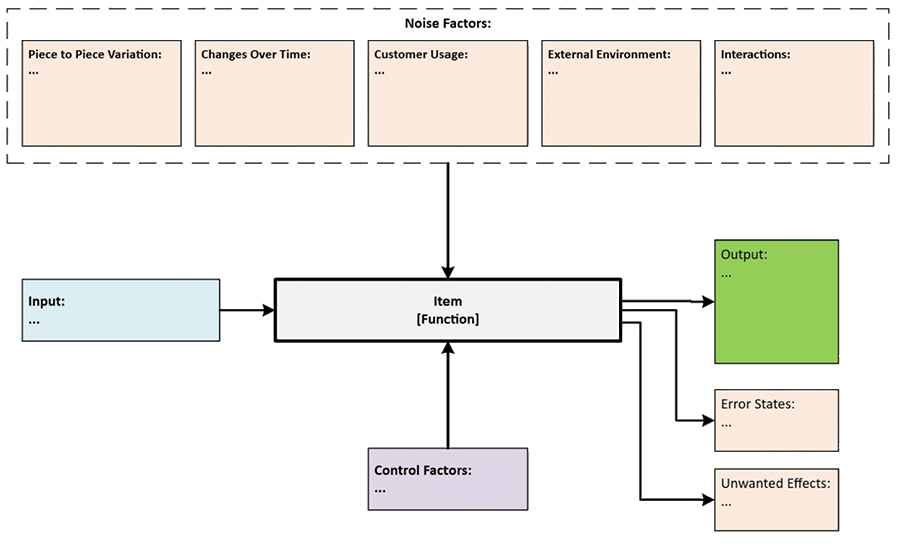
Mapping the Invisible Forces of Failure — P-Diagram Insight

Why It’s Underrated (But Crucial)

Most teams jump straight to DFMEA or PFMEA, skipping the groundwork. Here’s what happens when the P-Diagram is ignored:

  • Failure modes get missed because the system is not well understood
  • Noise factors (like temperature, voltage spikes, or misuse) are assumed instead of analyzed
  • FMEAs become checklists, not strategies

A well-structured P-Diagram ensures:

  • Failure analysis starts from function, not just components
  • You think like the system — from input to error to output
  • You capture the voice of real-world variation

The 6 Blocks of a P-Diagram

Here’s what a standard P-Diagram includes:

  1. Inputs (signals, energy, materials)
  2. Outputs (intended function, side effects)
  3. Control Factors (what you design or specify)
  4. Noise Factors (what you can’t control: environment, wear, user)
  5. Error States (malfunctions, unintended outputs)
  6. Functional Description (the core transformation happening in the system)

Real Example: Mobile C-Arm X-ray System

For a mobile C-arm X-ray system, we used a P-Diagram to break down the motor control system—the component responsible for precise movement and positioning of the C-arm around the patient.

ElementDescription
Inputs– User commands (joystick, touchscreen)

– Power supply

– Sensor feedback
Control Factors– Motor type and torque settings

– PID control parameters

– Gear ratios
Noise Factors– Friction variation

– Patient table load

– Power fluctuations

– Temperature
Ideal Output– Smooth, precise, and safe C-arm positioning
Error States– Jerky or delayed motion

– Position overshoot

– Incomplete motion path

– Overheating
Mechanism/Function– Electric motor drive

– Feedback control loop

– Mechani
From Inputs to Error States: How We Designed Robust C-Arm Motion

This structured approach helped us in several ways –

  • Clarified Interactions Early On: It forced the team to map the system boundaries—we realized the patient table weight influenced C-arm motion more than we expected.
  • Distinguished Controllable vs. Uncontrollable Factors: Separating control factors (e.g., PID parameters) from noise factors (e.g., load variation) helped in tuning motion profiles for better robustness.
  • Laid the Foundation for DFMEA: Once we had this breakdown, it was much easier to perform a DFMEA, evaluating risks like positioning failure or motor overcurrent due to specific causes.
  • Improved Collaboration Across Teams: The visual clarity of the P-Diagram helped align electrical, mechanical, and software teams—each saw how their domain influenced the output.

Using the P-Diagram for Strategic Reliability

Here’s how I recommend applying it:

  • Use it before your FMEA. It feeds the function list and potential failure modes.
  • Cross-functional teams only. You need design, systems, test, and field inputs.
  • Make it a living doc. Update it as your design evolves.

Conclusion: It’s Not Just a Diagram — It’s a Mindset

If you want to reduce surprises in the field, improve your FMEA quality, and design more robust systems, start with the P-Diagram.

It’s a simple tool — but its power lies in how deeply it forces you to think.

Are you using P-Diagrams in your design reviews? I’d love to hear how you’ve applied it.

Filed Under: Articles, on Product Reliability, Reliability by Design

About Laxman Pangeni

Laxman Pangeni is a seasoned Design and Reliability Engineer specializing in predictive modeling, data science, and advanced statistical analysis to enhance product performance and reliability across complex systems.

« 4: Design & Planning – Part 1: Design
How Do You Know What Functions to Include in an FMEA »

Leave a Reply Cancel reply

Your email address will not be published. Required fields are marked *

Reliability by Design series logo Photo of Laxman PangeniArticles by Laxman Pangeni
in the Reliability by Design article series

Recent Posts

  • Business Risk Hierarchy
  •  Developing Maintenance Strategy for a Sheet of Paper 
  • Work Quality Assurance with ACE 3T Standard Operating Procedures
  • The Power of Empowering Employees
  • Book Review: An Elementary Guide to Reliability

Join Accendo

Receive information and updates about articles and many other resources offered by Accendo Reliability by becoming a member.

It’s free and only takes a minute.

Join Today

© 2025 FMS Reliability · Privacy Policy · Terms of Service · Cookies Policy