
The lognormal distribution has two parameters, μ, and σ. These are not the same as mean and standard deviation, which is the subject of another post, yet they do describe the distribution, including the reliability function. [Read more…]
Your Reliability Engineering Professional Development Site
Find all articles across all article series listed in reverse chronological order.
The lognormal distribution has two parameters, μ, and σ. These are not the same as mean and standard deviation, which is the subject of another post, yet they do describe the distribution, including the reliability function. [Read more…]
This week in our CRE Test Prep class/webinar we covered the Advance Statistics section of the CRE Primer, and I felt great that we stayed an hour more going over these though topics.
One of the topics was Hypothesis Testing.
Let me share some of the questions that arose during that section. [Read more…]
A guest post by Andrew O’Connor, of Relken Engineering Pty Ltd
Common Cause Failures (CCF) is one of the reasons why a classical reliability model of your system may dangerously underestimate the risk of failure. It directly attacks the benefits of providing redundancy by creating a single point of failure. In fact, studies have shown that CCF events may contribute between 20% – 80% of the unavailability of safety systems within nuclear reactors [Werner 1994]. This post will “Describe this type of failure (also known as common cause mode failure) and how it affects design for reliability. (Understand)” [CRE BOK III.A.4] [Read more…]
Last week during our CRE Test Prep class, we were covering the Basic Statistics section in the CRE Primer and had several questions regarding Confidence Limits for Reliability.
All of them were fair questions, and when students are asking these types of questions, the class gets better… [Read more…]

The other day I got a question about the difference between ALT and HALT. There was some confusion probably because of the similar words in the acronym. ALT is Accelerated Life Test, and HALT is Highly Accelerated Life Test. [Read more…]
Failure mode and effects analysis, or FMEA, is a tool for the identification and prioritization of possible ways a product or process can fail. The intent is to use that information to make improvements to the product or process.
I think of FMEA (and related processes like FMECA, dFMEA, etc.) as structured brainstorms that provide a means to focus on what’s important. [Read more…]
The reliability goal is a key element across the entire product lifecycle. From product definition to determining warranty to judging performance, knowing the goal in clear terms sets the stage for a successful product.
Reliability in engineering terms is the probability of satisfactory product performance within a defined environment over a stated duration. [Read more…]
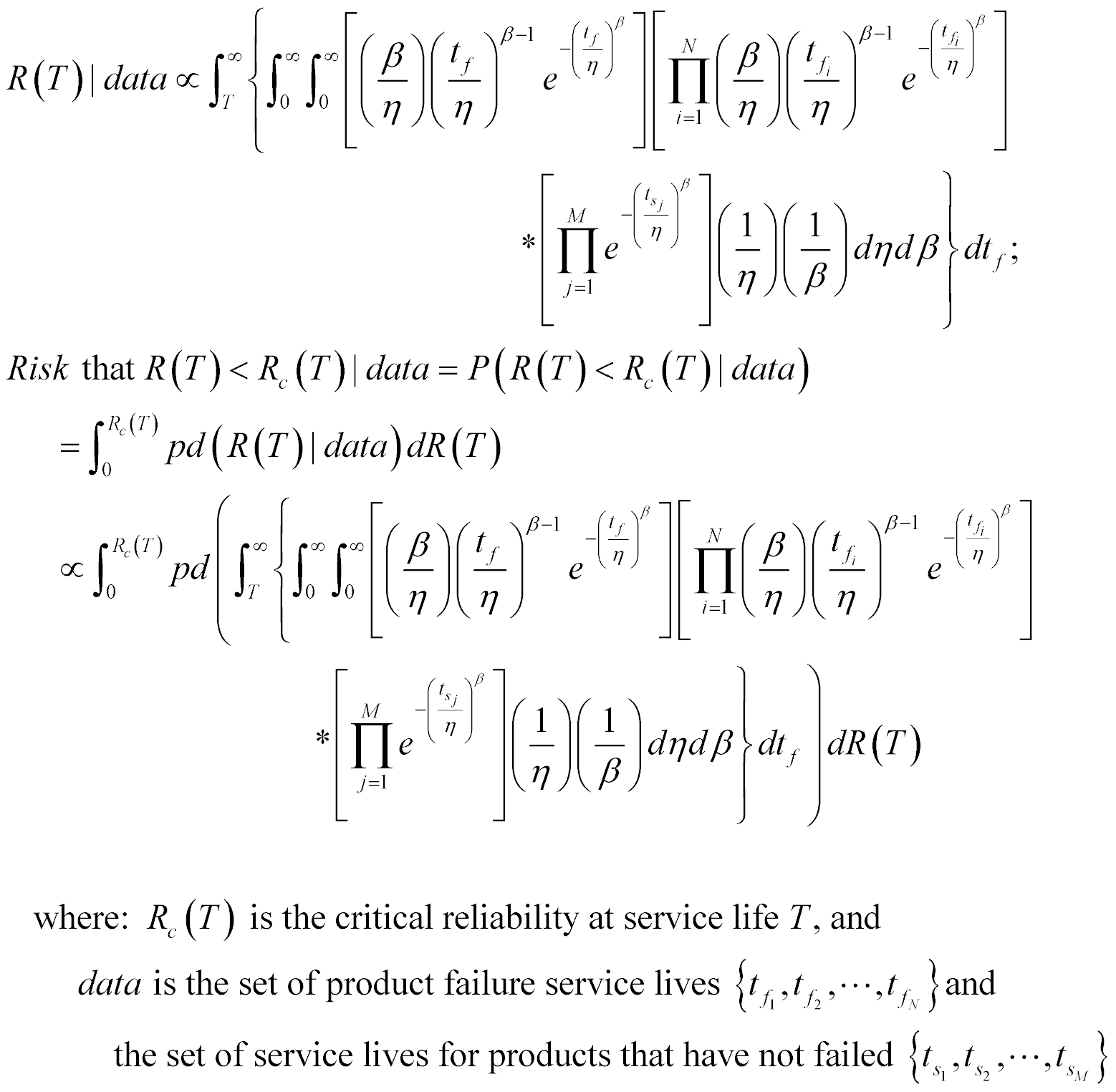
The term Bayesian Reliability Analysis is popping up more and more frequently in the reliability and risk world. Most veteran reliability engineers just roll their eyes at the term. Most new reliability engineers dread the thought of having to learn something else new, just when they are getting settled in the job. Regardless, it is a really good idea for all reliability engineers to have a basic understanding of Bayesian Reliability Analysis.
This series explains Bayesian Reliability Analysis and justifies [Read more…]

There a few different ways to sample a lot (or group) of material to determine if it has an acceptably low failure rate (or proportion that are considered ‘bad’). The following is an example of the sequential sampling method, which happens to be rather efficient by generally using the fewest samples for the same risk protection. [Read more…]

First the Question:
Fred,
Early in the FMEA lecture you worked through a homework problem and you mentioned that a cdf may not be linear (hence the reason for giving three points in a reliability goal). Can you give an example of two of things you’ve seen with non-linear cdf’s? I’ve only done limited reliability testing at this point, but everything I’ve done and every example I’ve ever seen have had linear cdf’s.
Thanks,
John
And, my response: [Read more…]
In a recent LinkedIn post a fellow Reliability Engineer is asking the Reliability Engineering community in how to prepare for the CRE exam. Rapidly everyone is recommending books, study groups, and training courses. My recommendation to anyone taking the CRE exam is to be very familiar with your approved ASQ calculator. Here is a link that I found in [Read more…]
EAM & CMMS Systems, 10 times more data in the system or 10 time less done with the data available?.
A nice short article about the problem of data, data, too much data.

The CRE_Errata_9-26-2011_revised document is in pdf format and contains a couple of typos noted by John Cooper in the Indiana Council CRE prep materials – he has taught the CRE Prep course for Ops A La Carte and is a pretty good teacher and a CRE. [Read more…]
Recently a colleague sent me a published copy of the first CRE exam. Scanning through the document suggests that a few things have changed and many have not changed at all. I often comment my enjoyment of the reliability engineering profession, as it doesn’t change too fast and even I can keep up. [Read more…]

A reliability block diagram (RBD) for a product that has no redundancy or complex use profile is often very simple. A series system (reliability wise) implies that any one part or element of the product that fails the entire product fails. One might ask if an RBD is even necessary. [Read more…]